Showing posts with label Google. Show all posts

Tuesday, November 21, 2017

It takes a village to identify false news

Filloux: A credibility scorecard
Liberal democracies are being tested around the world by the rapid diffusion of misleading or false information designed to influence voters.

It has happened in France, Catalonia, the U.K., and, of course, the U.S.

Many have proposed--for example, the World Economic Forum--that two of the most powerful vehicles for spreading information, Facebook and Google, should be responsible for filtering out material that is demonstrably false or misleading.

Versión en español. 

But it turns out that this is not easy to do. False information is often irresistibly appealing and moves too fast to be stopped.
Why we're Still in the Dark about Facebook's Fight Against Fake News -- Mother Jones
Nine experts offer opinions on how to fix Facebook -- New York Times

Not an editor, but a scorecard

What's more, it is hard to define false news in a way that can be automated by algorithms. Journalist and media consultant Frederic Filloux has developed the News Quality Scoring Project, which attempts to use automated systems to evaluate the likely credibility of a piece of news content. It doesn't label news as false or fake. It simply gives a credibility score based on a series of indicators such as a publisher's or a journalist's previous reliability.

Filloux's Publication Quality Score criteria


Facebook, Google, and Twitter themselves are working with the Trust Project on an automated system to display "trust indicators" alongside information they share with users.

Friday, September 22, 2017

Publishers look beyond Facebook, Google for revenues

A deal with the devil.

A new study by the World Association of Newspapers and News Publishers (WAN-IFRA) confirms what I have suspected for a long time: when publishers rely on Facebook for distribution, they are making a deal with the devil.

"Reality Check: Making Money with Facebook" was based on a survey of an "expert group" of 150 publishers. On average, Facebook was contributing only 7% of their revenues in spite of the fact that much of the publishers' content was being consumed on that platform.

And Facebook is stingy when it comes to sharing revenue with publishers, compared with Google, Spotify, Twitter, and others. It "seems to share proportionally less revenue with content creators than other platforms do."

Loss of branding power

The WAN-IFRA findings are also troubling because studies by Pew Research (see paragraph 4 of the study) and the Reuters Institute for the Study of Journalism (see p. 16 of the study) have shown that users think Facebook or Twitter produced news stories that were actually produced by a news organization. In other words, news organizations are losing their brand identities in social media.

If news organizations are going to have a chance of survival in the new digital economy, they will need to rely on the power of their brands  as trusted sources to persuade people to pay for their content.

Monday, March 20, 2017

How quality content can win in the long run

Digital advertising is broken for many publications.
Back in the days when my job was persuading advertisers to spend money with our business publication, I would talk about the importance of a client's ad appearing next to credible, high-quality content. Editorial environment matters, was the argument.

Google, Facebook, and Yahoo pretty much destroyed that business model. They promised advertisers to deliver their ads to specific demographic groups with little waste -- for example, female executives in Baltimore who have searched for information about luxury automobiles in the past year. And their prices were much lower. 

But the importance of high-quality, credible content has just resurfaced in a big way. Some major advertisers in England pulled their ads from Google and YouTube because their ads were placed next to content of extremist organizations promoting hate speech.

Among those pulling ads were French advertising giant Havas, the BBC, the UK government, and The Guardian newspaper. The Times of London first broke the story (paywall). 

What this means is that digital publications can compete with Google, Facebook, YouTube and the rest by relying on a relationship of trust and confidence rather than scale -- totals of eyeballs. 

Tuesday, November 8, 2016

Media value lies in relationships, not scale

Amid all the news about how Facebook and Google are devouring the world, I would like to sound a note of optimism for digital news media. But first, let's acknowledge the bad news.

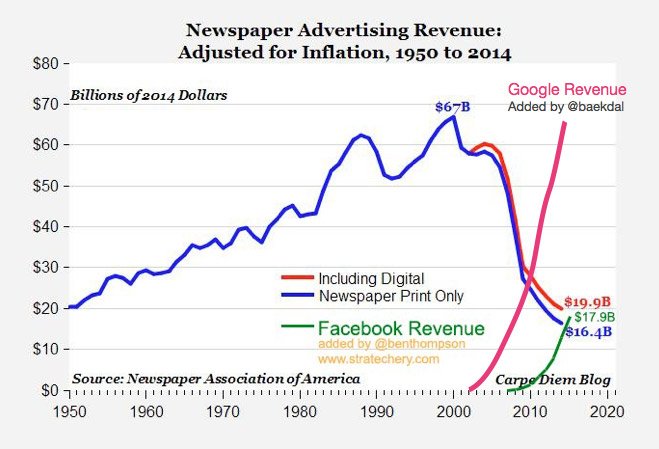
It is true that the munch munch munch you are hearing is the sound of the Internet giants biting off big slices of the digital advertising pie. However, much of that has been at the expense of traditional news media. There is an opportunity for digital-only news media to fill the gap in local coverage.

In the short term, this is not something to celebrate, since the decline of newspapers in particular has led to a big loss in watchdog journalism on the local level. The chart below, which has been published widely, shows the rise of Facebook and Google's advertising revenue concurrent with the decline in newspaper ad revenue.

With information from Thomas Baekdal @baekdal and Ben Thompson @benthompson of Stratechery.com.

Friday, March 11, 2016

Is Facebook swallowing journalism? Embrace it, says Washington Post's digital chief

Emilio Garcia-Ruiz speaks to the press in Huesca. Photo by EFE
HUESCA, Spain -- Yes, it’s good to have a billionaire owner with patience, but it’s even better to have a billionaire owner with a vision.

And the vision of Washington Post owner Jeff Bezos is that a news organization has to make its work available free, everywhere.

Bezos is urging the publication's journalists to adopt the principles of retail sales that he has learned over the years in running Amazon, America's largest online retailer of practically everything.

And the man who is putting that vision into practice is Emilio Garcia-Ruiz, the Post's managing editor for digital.

Versión en español

A fundamental concept in retail strategy is the sales funnel, Garcia-Ruiz said in his keynote address March 10 at the Digital Journalism Conference in Huesca, Spain. The idea is to get as many people as possible to sample your product (in journalism, it's through sharing in social networks), get them to pay for a product, and then make them repeat buyers for higher-value products. At each stage the pool of customers is smaller but spending more.

The key in a business sense, said Garcia-Ruiz, is to keep expanding that pool at the top of the funnel, just as Amazon has done in retail. And from a journalism perspective, the key is to merge the best journalism with the best technology to keep people coming back for more.

Sunday, February 28, 2016

New mobile platforms aid users, penalize publishers

News publishers are again the pawns in a chess game among the big technology platforms, mainly Google, Facebook, and Apple.

And while publishers are losing control of their future, users are gaining a better experience with pages that load faster on mobile devices.

This is the scenario that is emerging with the expanded rollout of Facebook's Instant Articles, Google's Accelerated Mobile Pages, and Apple's iOS9 and News products.

I have spent a weekend reading over expert commentaries on the business and technical aspects of the latest innovations in Internet technology. What all three of these innovations have in common is that they are aimed at serving mobile users better and that they claim to help publishers gain revenue, audience, and data about users. Many of the commentators are worried that publishers are losing out to the platforms.

Nilay Patel, editor-in-chief of the Verge, was warning back in November that the battle among Google, Facebook, and Apple to corral mobile users and advertisers would cause the most damage to independent digital publishers on the open Web.

Sunday, August 9, 2015

Jarvis's new role for journalists: be the organizer

Jarvis: think first of the community
Several years ago I was working in Belarus, a former Soviet republic, where independent newspapers have a hard time surviving. The government denies them access to state-monopoly newsstands, overcharges them for their newsprint, and harasses them at every turn.

We looked at one publisher's website data to see if he might have an opportunity to generate revenue online. Turns out the website's most popular page contained the community's bus schedules. And what's more, his community spent more time on that page -- 5 minutes, 30 seconds per visit -- than any other. This publisher, a journalist, was humbled to see that a simple list was more important to his readers than the journalism.

The Belarus example came to mind as I was reading Jeff Jarvis's new book, in which he talks about a new role for journalists: "Helping a community better organize its knowledge so it can better organize itself." 

Friday, April 24, 2015

Deal with the Devil: Facebook, Google, mobile apps


A deal with the devil.
Versión en español

It was the science fiction writer Arthur C. Clarke who wrote, "Any sufficiently advanced technology is indistinguishable from magic." And clearly many people think that way about applications for smartphones.


Mobile apps can show us detailed maps of most places on earth. 
 
They can read QR codes that tell us when the next bus is coming to this stop. 
 
They alert us to the scores of sporting events we care about. 
 
They allow us to send text messages, free, to billions of people anywhere in the world (WhatsApp and WeChat users alone account for nearly 2 billion).
 
So we willingly give ourselves over to these services that do all these amazing things for us. Often we sign in to them using our Facebook or Google or Twitter accounts, thereby giving those social network platforms access to information about our preferences for products, who are friends are, where we are dining, and how we are amusing ourselves.
 

Friday, December 5, 2014

Freedom of the press for those who own one (or a search engine or a social network)

A renowned media critic sounded the alarm in 1960 about corporate takeovers of newspapers and layoffs of hundreds of journalists. He worried that the power of the press was being concentrated in too few hands.

Liebling, from Slate.com

It was in his column in the New Yorker, The Wayward Press, that A.J. Liebling tossed off one of his most memorable lines in a parenthetical aside:
"Freedom of the press is guaranteed only to those who own one" (New Yorker, May 14, 1960, p. 109, paywall). 

What is still true today is that corporate owners of newspapers are focused on maintaining their profit margins and are laying off journalists to do so. The newspaper and magazine industries have lost 54,000 journalism jobs since 2003.

But it is no longer true that newspapers monopolize production and distribution of news. The Internet has given everyone with a computer and Internet access their own printing press. You do not have to be a mogul to publish your opinions. The big question is can you get anyone to listen.

Thursday, February 20, 2014

7 mobile stats that should scare digital publishers

After years of predictions that this year would be the year of mobile, finally it has arrived. So here are some numbers that should prompt strategizing and action by digital media publishers.

1. Web traffic from mobile devices was up 78 percent year over year in mid-2013, and 109 percent over 2011, according to Ayaz Nanji, writing in Marketing Profs.

To cite one prominent media example of the trend, ESPN has been registering more than half of its traffic from mobile. For publishers the message is clear: you need a mobile app or mobile-friendly version of your content or your audience will leave you behind.

2. In 2013, for the first time, Americans spent more time on their mobile devices every day than on the desktop, according to eMarketer.  Mobile's share of daily time spent, 19.4 percent, is the only category that grew in the past year: television, desktop computers, print and radio all declined, as they have each year since 2010.

3. As of the fourth quarter of 2013, almost half of Facebook's $2.6 billion in total revenue came from advertising sold on mobile devices. This is the world's largest social network, with half a billion daily active users. Facebook has made it clear that it is betting heavily on mobile. Why? Because about three-fourths of its users are there. (As a point of comparison, three-fourths of Twitter's audience and 65 percent of its ad revenues come from mobile. )

Thursday, August 15, 2013

Bezos purchase of Post has parallels in China

Versión en español aquí.

Amazon's Jeff Bezos isn't the only e-commerce billionaire making news with acquisitions. Jack Ma, chairman of China's e-commerce leader, Alibaba, has invested hundreds of millions of dollars in a Twitter-like microblogging service and a mapping service.

Both of these giants have been bolting on companies that can help them gain synergies by combining content, social networks, internet retailing, mapping (location-based selling and services), mobile platforms, devices and operating systems. 

Their model and chief competitor is Google, the worldwide leader in online advertising. Google has been getting into all of these businesses. In order to compete globally, the big internet companies -- like Facebook, Amazon, Yahoo, Twitter and, in China, Alibaba and TenCent -- are seeing the need to develop all parts of online business. 

Monday, March 26, 2012

Guardian's Facebook app challenges Google

A new Facebook app launched by The Guardian in England could signal a major challenge to Google’s dominance of referral traffic to news websites.

Google used to drive 40 percent of The Guardian’s traffic, but social networks referred more than search several times in February, said Tanya Cordrey, director of digital development at Guardian News and Media.

In the U.S., Google refers a third of the traffic to news websites, four times more than Facebook, according to The State of the News Media 2012.

Nifty new app

Much of The Guardian’s Facebook traffic is attributed to an app that has been downloaded 8 million times since its launch in September, according to Journalism.co.uk.

“The ‘frictionless sharing’ app works by readers opting in to share all articles they read with their Facebook friends, generating more traffic for the news site with ‘no editorial curation’,” the site reported. 

It is not clear how this app might be different from or better than those used by other news organizations. But if something similar were adopted at U.S. media, Facebook could become more of an ally of news organizations instead of just a competitor for readers’ time.


Related:

Google takes magic out of advertising sales process
Social media challenge Google for news distribution
Facebook to overtake Yahoo in display advertising
Total users and pageviews are misleading measures of web traffic
Robert Niles: How to Make Money Publishing Community News Online
Making money Part I: Advice from Mark Briggs
You don't need all the skills to get started
How much to charge advertisers? As much as possible
More paywalls won't save journalists' jobs

Tuesday, March 1, 2011

Facebook to overtake Yahoo in display advertising

The rich are getting richer in the online advertising market, which means the antitrust lawyers must be sharpening their pencils. eMarketer is forecasting that Facebook will have one-fifth of the online display advertising market in 2011 and will displace Yahoo as leader in the category.  
The digital research website is also predicting that the top four companies in the category -- including Google and AOL -- will have more than half the market by year-end. 

Google is a relative newcomer to display ads, but it dominates search-related advertising with its AdWords service, which will have three-fourths of the U.S. market in 2011, eMarketer predicts.

Google’s vast storehouses of data on consumer behavior, collected through its analysis of billions of searches, allow it to target display ads more effectively than some of its competitors.
All of these big players have automated ad-delivery systems that reduce the need for salespeople and cut costs to advertisers in terms of cost per impression, cost per click on an ad or cost per transaction. It is tough for smaller advertising networks to compete.

Tuesday, February 22, 2011

Google takes magic out of advertising sales process

Una versión en español se encuentra aquí.

In a confrontation between Old and New Media in 2003, Mel Karmazin, CEO of Viacom, told the founders of Google that their advertising sales program was "messing with the magic" of sales.

Google’s Adwords told advertisers exactly how many people were exposed to their ads and how many clicked on them, as well as other specific data.

The model for selling advertising espoused by Karmazin and the Old Media was, "Advertisers don’t know what works and what doesn’t...You don´t want to have people know what works. When you know what works or not, you tend to charge less money than when you have this aura and you’re selling this mystique."

Friday, February 18, 2011

Twitter valuation of $8 billion hints of a bubble

The whole world knows how Twitter and Facebook gave power to the people and overthrew dictators.  

Events in Tunisia and Egypt did more to advertise the power of these social networks than multimillion-dollar campaigns.

Still it was a surprise to read recently in the Wall Street Journal that some investment analysts were putting a market valuation of $8 billion on Twitter. In an informal poll on the Journal‘s website, 80% of the readers said Twitter was not worth that much.