Showing posts with label digital advertising. Show all posts

Sunday, May 27, 2018

Publishers pivot toward users and credibility, away from digital advertising

For those who could not attend the annual convention of the Spanish Journalism Society (SEP, Sociedad Española de Periodística, in Malaga, Spain, May 24-25, below is a summary of my keynote address. (Here are slides of the English version, presented Sept. 22 at the Creima Conference in Oporto, Portugal.)

The talk focused on two major trends in digital journalism that are taking place in many places around the world. The slides highlight examples of media from France, Holland, Mexico, the U.S., Germany, Peru, England, Colombia, Argentina, and Brazil, among others.

Photo by José María Legorburu

1. Publishers are pivoting toward users and away from advertisers and investors as their main source of financial support. The business model that depended on advertising to support journalism is moribund and nearly dead. The automated buying and selling of advertising is controlled by the duopoly of Google and Facebook, which have more and better data about news publishers' users than the publishers' themselves. Publishers have no way to compete with that dominance of programming and targeting of ads. It's time to burn the ships and not look back. 

2. Amid the flood of junk, misinformation, clickbait, and false information, the added value of a news organization will spring from its credibility. News media need to build credibility and trust by interacting more directly with their audiences, listening to their audiences, adopting transparency about their owners and investors, detailing their funding sources and spending practices, and, above all, doing investigative journalism that holds political and business leaders accountable for their actions. 


Because of these two trends, there are 10 new paradigms for digital journalism:

Saturday, May 26, 2018

Users will own the media: how journalism is evolving

Alfredo Triviño has worked largely behind the scenes on some of the biggest digital media projects for some of the biggest brands in the world. But you might not have heard of him.

Alfredo Triviño: users will own the media, in every sense
He spent seven years in senior management roles at News Corp., ultimately as director of innovation, where he worked on development of a pay model for digital journalism and on long-term editorial and commercial growth strategies. (He is a 1999 graduate of the University of Navarra School of Communication, where I teach.)

He was invited to give the closing keynote address last week to the annual conference of the Spanish Journalism Society (SEP, Sociedad Española de Periodística). He ruminated casually about trends he sees in the worlds of digital journalism and digital commerce, mixing some English terminology into his Spanish presentation. Among the shifts he sees:

A shift from journalism and commerce to journalism vs. commerce. That is, the two will operate in separate worlds. Journalism will depend on the support of user communities rather than advertising. Brands will create their own digital media rather than publishing their messages on TV, radio, and in print.

Versión en español

A shift from paid editorial (subscriptions) to shared ownership. By this Triviño meant that groups of users will form around a topic of shared interest--local news of a community, a social issue, or a shared cultural interest, for example. They will be active participants rather than passive consumers. They will interact with the journalists, suggest topics to editors, share their knowledge, create content, contribute money, and support the mission of the publication because they feel they are part of it and it speaks for them. "This is ours; we own it".

Saturday, April 7, 2018

Restoring trust: Nieman Lab's helpful list of news credibility projects

These projects aim to restore trust.
In a blog post earlier this year, I wrote about the importance of Credibility as the new currency of journalism, its significance in an era of distrust of the media, and its economic value for high-quality journalism.

A big thank you to Christine Schmidt of Nieman Lab who has just produced a helpful list of news credibility projects. Among other things, it shows how the Knight Foundation is giving help to many of them.

Below is an abbreviated form of Schmidt's list, with a few details on each project. 

Trusting News
Participants/partners: Mainly local newsrooms, such as WCPO, the Fort Worth Star-Telegram, St. Louis Magazine; also A Plus, Religion News Service, CALmatters, Discourse Media, USA Today

The Trust Project
Participants/partners: News outlets like the Washington Post, The Economist, the Globe and Mail, Mic, and Zeit Online; tech companies like Facebook, Google, Twitter, and Bing; Institute for Nonprofit News

News Integrity Initiative, Based at CUNY Graduate School of Journalism
Participants/partners: The following groups received grants from the initiative’s first round of funding: Arizona State University’s News Co/lab, Center for Investigative Reporting, Center for Media Engagement, EducationNC, Free Press, Listening Post Collective, Maynard Institute, OpenNews, Public Radio International, The Coral Project; Internews and the European Journalism Centre have also received funding


Monday, February 12, 2018

Where the jobs are for graduates in journalism

"The new journalism specialties". The graphic shows that 56% of the Spanish journalists surveyed work in media that have community managers, and 30% employ data and traffic analysts. Click to enlarge the graphic.
Where will the jobs be for graduates in journalism and communication? The results of a survey of journalists in Spain give some indication. The urgent demand is for people with digital media skills, but more on that in a minute.

The Press Association of Madrid's (abbreviated to APM in Spanish) 2017 survey was sent to 13,500 professionals, and the overall response rate was a respectable 13%. A little more than a third were working in journalism while another third were working in other professions or were retired or semi-retired. The remaining 30 percent were working in communications, mainly advertising and public relations. (News articles about the survey are here, here, and here in Spanish.

Disconnect in training

The survey results show that the respondents to the survey are not the ones who are filling the new digital media jobs in their newsrooms. For example, 56% of the respondents said their publications had digital community managers--the people responsible for interacting with users in social networks and other channels--while only 13% of the respondents said they were working in those jobs.

Thursday, January 18, 2018

How publishers can overcome loss of Facebook traffic

Now that Facebook has made clear that it will not be promoting journalism to its users, all of the publishers who were getting much of their traffic there should look elsewhere. (Frederic Filloux of Monday Note has one of the best analyses of the company's announcement.)


What now? Well, there are several tactics and strategies that publishers can take to replace what they have lost (and will lose) from Facebook's pivot away from news. (I have also written about such strategies in Spanish.)

1. A tactic: start an email newsletter with links to your content. Think of it as a walled garden that protects you from Facebook.

Daily, weekly, or monthly newsletters create a more intimate relationship with users. Some publications have several on different topics, such as technology, business, public safety, or politics that users can select from. Local news sites in particular can benefit from daily newsletters.

The links to your content send users directly to your site, and any ad revenue goes to your business rather than Facebook. Many digital news publishers report higher response rates from email subscribers to offers of subscriptions, premium content, or memberships.
 

2.  Focus on the quality of users instead of the quantity: relationship rather than scale, engagement rather than volume.

The metrics of the "attention web" focus on showing the value of the audience's relationship with the media brand rather than with an advertiser's product.

Wednesday, January 3, 2018

2018: Credibility will be the new currency for journalism

An organization I work with that promotes development of independent media in Latin America, SembraMedia.org, recently asked me to make some predictions for 2018.


I really had just one: Credibility will be the new currency of journalism in 2018 and the years to come.
 

But to explain, here are that prediction's corollaries:


1. Independent media--those based on serving the public rather than turning a profit---will grow in importance through revealing corruption and holding authorities accountable. There are many examples. In the U.S., organizations such as ProPublica and Texas Tribune; in Spain, eldiario.es; in Peru, OjoPúblico; in Colombia, Connectas and La Silla Vacía; in Mexico, Aristegui Noticias and Animal Político; in Argentina, Chequeado; and hundreds of others around the world.


2. These independent media that serve the public first rather than political or economic interests will gain credibility by challenging the powers that be. That credibility will have economic value that will be monetized through support from NGOs, foundations, consumers, wealthy donors, and service-oriented organizations.

3. Journalism will continue its transformation from a business to a public service, and traditional media that view journalism as a business will accelerate their own decline. The traditional media's focus on maintaining profit margins will cause them to continue gutting their staff, their products and their services. They will have neither the will nor the means to make the needed investments in personnel and technology to transition to the world of multimedia, interactive, multiplatform, interactive journalism. (There are a handful of exceptions.)

Monday, March 20, 2017

How quality content can win in the long run

Digital advertising is broken for many publications.
Back in the days when my job was persuading advertisers to spend money with our business publication, I would talk about the importance of a client's ad appearing next to credible, high-quality content. Editorial environment matters, was the argument.

Google, Facebook, and Yahoo pretty much destroyed that business model. They promised advertisers to deliver their ads to specific demographic groups with little waste -- for example, female executives in Baltimore who have searched for information about luxury automobiles in the past year. And their prices were much lower. 

But the importance of high-quality, credible content has just resurfaced in a big way. Some major advertisers in England pulled their ads from Google and YouTube because their ads were placed next to content of extremist organizations promoting hate speech.

Among those pulling ads were French advertising giant Havas, the BBC, the UK government, and The Guardian newspaper. The Times of London first broke the story (paywall). 

What this means is that digital publications can compete with Google, Facebook, YouTube and the rest by relying on a relationship of trust and confidence rather than scale -- totals of eyeballs. 

Tuesday, March 14, 2017

Winning digital strategy: Think first of the community you serve, not the audience you sell to

You already know the story well -- how the business model for traditional media collapsed in the U.S. (Pew: State of the News Media 2016).

And how digital advertising's market share surpassed print and will overtake television this year.

And how media organizations have responded by cutting staff and weakening their products in order to keep profit margins high -- newspapers eliminated 20,000 jobs in 20 years  (p. 17), a 39% decline in employment.

All of this has been done to serve advertisers and investors at the expense of the most important people in the media equation -- the public, the readers, the users. But now publishers are rediscovering the importance of focusing on serving readers.

Readers, viewers rule

Now that digital media have broken up that arranged marriage of advertising and news content, publishers are realizing once again that their business is a public service and that the most important people in the equation are not the investors and the advertisers but the public.

Tuesday, November 8, 2016

Media value lies in relationships, not scale

Amid all the news about how Facebook and Google are devouring the world, I would like to sound a note of optimism for digital news media. But first, let's acknowledge the bad news.

It is true that the munch munch munch you are hearing is the sound of the Internet giants biting off big slices of the digital advertising pie. However, much of that has been at the expense of traditional news media. There is an opportunity for digital-only news media to fill the gap in local coverage.

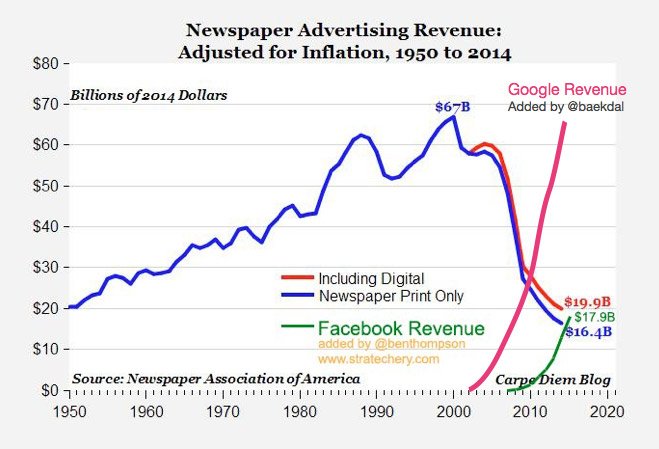
In the short term, this is not something to celebrate, since the decline of newspapers in particular has led to a big loss in watchdog journalism on the local level. The chart below, which has been published widely, shows the rise of Facebook and Google's advertising revenue concurrent with the decline in newspaper ad revenue.

With information from Thomas Baekdal @baekdal and Ben Thompson @benthompson of Stratechery.com.

Friday, July 22, 2016

'Distributed content' expands reach, weakens influence of news organizations

The following is an excerpt from my chapter of a book on digital news media that will be published shortly, in Spanish. 

Among the most important developments in digital journalism in 2015 was the emerging practice of creating, distributing, and monetizing news known as "distributed content". 

Bell: 'Facebook is eating the world.'
What it means: news media organizations hand over their content to platforms like Facebook without linking back to their own websites so that smartphone users can get nearly instant access to the content without having to wait five to 10 seconds for it to display -- an eternity for impatient mobile consumers.

Versión en español

Snapchat was the first platform to stake a claim in this new territory of competition when it launched its Discover channel in January of 2015. Facebook followed in June with its “Instant Articles”, and others such as Google, Instagram, and Apple quickly jumped on the bandwagon.

These social and technological platforms had at least three motivations, according to Josh Constine of Tech Crunch. They wanted to avoid having users abandon a link to news content because of a slow download; they wanted to keep users in their own walled gardens to prevent them from going to other platforms; and, finally, they wanted to take advantage of the audience's attention to send them targeted advertisements, tailored to their personal tastes, preferences, and buying habits.

Sunday, February 28, 2016

New mobile platforms aid users, penalize publishers

News publishers are again the pawns in a chess game among the big technology platforms, mainly Google, Facebook, and Apple.

And while publishers are losing control of their future, users are gaining a better experience with pages that load faster on mobile devices.

This is the scenario that is emerging with the expanded rollout of Facebook's Instant Articles, Google's Accelerated Mobile Pages, and Apple's iOS9 and News products.

I have spent a weekend reading over expert commentaries on the business and technical aspects of the latest innovations in Internet technology. What all three of these innovations have in common is that they are aimed at serving mobile users better and that they claim to help publishers gain revenue, audience, and data about users. Many of the commentators are worried that publishers are losing out to the platforms.

Nilay Patel, editor-in-chief of the Verge, was warning back in November that the battle among Google, Facebook, and Apple to corral mobile users and advertisers would cause the most damage to independent digital publishers on the open Web.

Monday, September 14, 2015

News thrives on smartphones, but publishers don't

The big players in digital news like The New York Times, Buzzfeed, and NBC News are struggling with a change in how they make money and how they define themselves as brands.

The cause is the rapid migration of news consumers and advertisers to smartphones. This migration has put the news brands at the mercy of Internet giants Facebook, Google, Apple, and others who already monopolize digital advertising.

Alan Mutter, the @newsosaur, has a deep dive on the trend and what it means for publishers.

In essence, the news publishers have discovered that much of their audience -- in some cases, most -- is accessing their content on smartphone applications provided by the big technology platforms and social networks. This means that the publishers are losing control of their users and revenue.

So the publishers have started doing something that looks like syndication of their product to the social networks and platforms. They tailor content to live on each of the platforms rather than their own -- distributed content, as described by Joshua Benton of Nieman Lab -- to increase the speed that users can access text, photos, and video (crucial on handheld devices).

Monday, June 15, 2015

Mobile metrics are failing publishers and advertisers

According to eMarketer, half the digital ad spending this year will be on mobile, a total of $29 billion.

Advertisers want to know if their messages are reaching the right target groups of people at the right time so that ad dollars are not wasted. Some people are better targets than others for messages about, say, infant car seats, or trips to Mexico, or eye makeup, or Hummers.

It is not a simple matter to measure Internet traffic, whether on the web or on mobile apps. But metrics matter to advertisers, who use them to determine the amount they are willing to pay for having their messages in a digital publication.


Advertisers want to know not only the size of the audience, but its characteristics -- income, location, interests, spending habits, hobbies, and more.

But for technical reasons, it is difficult to track a single user across all the devices they may use at home, at work or on the go -- smartphone, tablet, laptop, desktop. Cookies, those bits of information placed on your browser when you visit a web site, are great for tracking people and giving hints about what they are searching for and are interested in, but not when they move into the walled gardens of mobile devices and applications. (The technical reasons are explained in an article by the Internet Advertising Bureau.)

Saturday, March 3, 2012

It's "digital first" from here on in news biz

The digital publishing industry will hit a significant milestone this year when for the first time it will book more ad revenue than all print newspapers and magazines.

The really bad news for print media, even those with robust web operations, is that most of the revenue is going to non-print publishers such as Google, Yahoo, Facebook and others.

Monday, January 23, 2012

Using "Mad Men" advertising model for the web

Here in China, one of my guilty pleasures is watching DVDs of old episodes of "Mad Men," the cable television hit about the glory days of advertising and mass media in the 1960s.

In one episode, when Don Draper's advertising firm loses the multimillion-dollar Lucky Strike cigarette account, he takes out a full-page ad in the New York Times to announce that the firm will no longer accept tobacco advertising, supposedly because tobacco endangers the public health.

The power of display advertising

Draper has no doubt about the importance of announcing this to the public at large even though the target audience for the ad is very small, perhaps 1% of the audience of the Times -- other advertising executives, the CEOs of tobacco firms and other major advertisers, the firm's own clients.