Showing posts with label metrics. Show all posts

Tuesday, November 8, 2016

Media value lies in relationships, not scale

Amid all the news about how Facebook and Google are devouring the world, I would like to sound a note of optimism for digital news media. But first, let's acknowledge the bad news.

It is true that the munch munch munch you are hearing is the sound of the Internet giants biting off big slices of the digital advertising pie. However, much of that has been at the expense of traditional news media. There is an opportunity for digital-only news media to fill the gap in local coverage.

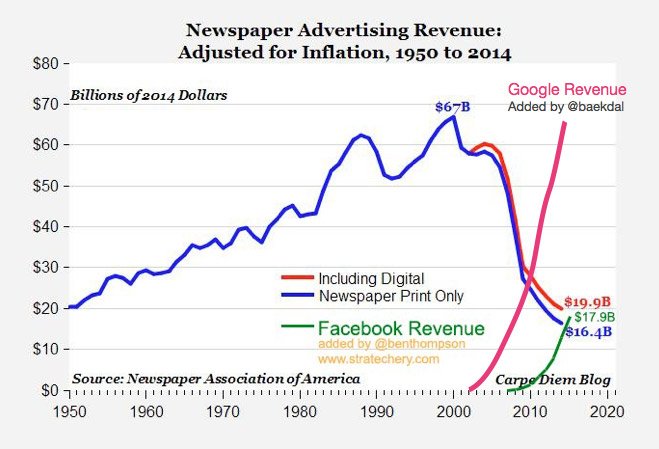
In the short term, this is not something to celebrate, since the decline of newspapers in particular has led to a big loss in watchdog journalism on the local level. The chart below, which has been published widely, shows the rise of Facebook and Google's advertising revenue concurrent with the decline in newspaper ad revenue.

With information from Thomas Baekdal @baekdal and Ben Thompson @benthompson of Stratechery.com.

Tuesday, July 12, 2016

Forget about the big numbers; go for loyalty, trust

Anyone who has studied the metrics of the internet in any detail knows about the Big Lie: those big numbers of total users and page views that everyone relies on are practically meaningless.

Jon Slade of the Financial Times
In other words, millions of clicks or millions of users are not an indication of trust in a particular news brand or loyalty to that brand. We need new metrics, better metrics.

Versión en español

So it was heartening to see this reality affirmed by of one of the leading lights of digital media innovation, Jon Slade of the Financial Times, in an interview with Ian Burrell (thanks to NiemanLab for the lead):
“I've seen data recently that says that of all the pages on the internet less than 1% of them are from newspapers – the vast majority of time spent is with social channels and they are always going to be much bigger than you are – so if you’re trying to play a game of scale then you’re going to lose.”
There are only a few international brands that have even a slight chance of competing with the likes of Facebook and Google for the digital advertising dollars that are based on the number of eyeballs delivered to specific ads.

Monday, June 15, 2015

Mobile metrics are failing publishers and advertisers

According to eMarketer, half the digital ad spending this year will be on mobile, a total of $29 billion.

Advertisers want to know if their messages are reaching the right target groups of people at the right time so that ad dollars are not wasted. Some people are better targets than others for messages about, say, infant car seats, or trips to Mexico, or eye makeup, or Hummers.

It is not a simple matter to measure Internet traffic, whether on the web or on mobile apps. But metrics matter to advertisers, who use them to determine the amount they are willing to pay for having their messages in a digital publication.


Advertisers want to know not only the size of the audience, but its characteristics -- income, location, interests, spending habits, hobbies, and more.

But for technical reasons, it is difficult to track a single user across all the devices they may use at home, at work or on the go -- smartphone, tablet, laptop, desktop. Cookies, those bits of information placed on your browser when you visit a web site, are great for tracking people and giving hints about what they are searching for and are interested in, but not when they move into the walled gardens of mobile devices and applications. (The technical reasons are explained in an article by the Internet Advertising Bureau.)

Thursday, December 12, 2013

Analytics is undercounting engagement of your users

Versión en español aquí.

The two most important traffic measurements for news entrepreneurs are NOT unique visitors and page views. Those numbers can mislead you. They count people who arrive at your website by accident or search, glance at a page and leave.

As Ken Doctor has so eloquently put it:
"Unique visitors are a great dumb count. As I’ve noted, it’s as if in the print world we counted the everyday subscriber — consuming 5 hours a month of a news publication — the same as someone who, standing on a Midtown corner on a windy day, happened to catch a sheet of flying newsprint as she held up her hand to hail a cab."
By contrast, the two measures that should really matter to you are:

  • engagement -- how long a visitor is on your site per visit and how many pages they view
  • loyalty -- how many times they return per day, week or month

Friday, August 26, 2011

Going beyond metrics of page views and visitors

This is Part 1 on going deeper in Analytics.

Publishers of digital news sites have a chance to know their audience far better than their print counterparts ever could.

The data available in tools such as Google Analytics lets you see when people are using your site, where they live and how loyal they are. 

Let’s start with the dashboard page. 

Click to see a larger image.


To the upper left, a click on "Visitors", "Traffic Sources" or "Content" will give you a more detailed profile of your users. To the bottom, the same is true with the six measurements that are visible.

If you click on "Visits", you can compare the traffic on particular days of the week to see if your users have a preference. 

(Click to see a larger image.)
Tuesday July 26 was a big day for traffic; maybe there was a big story published that day. No other pattern seems to emerge. 

The publisher at the site above should analyze his content to see what was so popular on July 26. 

Within Analytics you can see the pattern for the entire month, or whatever period you choose. One of the participants in a recent session was able to see that Mondays were the big day for traffic on his site.

Possible responses? He could look at the popular content on Mondays and produce some of it on other days of the week to keep traffic steady. Or maybe he should follow his users’ lead and produce more content for the Monday audience. 
(Click to see a larger image.) Traffic starts rising at 6 a.m.


While you are within the "Visits" section, you can change the view from days of the week to hours of the day with the buttons at the upper right. Then you can see the pattern of use by hour for the entire month. 

By looking at the entire day, you can make editorial decisions about staffing levels or deadlines. For example, at El País in Spain, site traffic starts rising rapidly at 9 a.m., so the editorial department starts work several hours earlier to produce fresh content for this audience. A second peak in traffic occurs in late afternoon, so fresh stories and updates are ready for this audience.

Let the data help you decide when to publish and when to update stories during the day. 

Know where your audience lives

Part 2 of going deeper in Analytics.

 While consulting for a Mexican newspaper group, I had them dig into their Analytics report to see where their users lived. They were surprised to find out that 40% of the audience for their provincial papers was in Mexico City, evidently for work.

 What were the implications of that finding? Two possibilities:
  • Perhaps they should look for advertisers based in Mexico City who wanted to reach an audience that moves between the two regions -- travel services, real estate agents, telephone services and so on. 
  • Maybe their editorial coverage should reflect the special interests of Mexico city residents living away from their home provinces. 
  • What are some others? 
The publishers of a Latin American website focused on the country’s leading soccer team found that more than a third of their audience lived in the United States. This attracted the attention of a potential advertiser,  a U.S.-based cable television service that carried games from Latin America.

The lesson: you need to know where your audience is accessing your site, for editorial and marketing reasons. Here is how you can do that.

Start in the Dashboard at the upper left. Click on Visitors, then click on Map Overlay and you will see a list of countries. Click on any of them and you will see a breakdown by city or, in the case of the U.S., by state. Then you can click down further for information about particular cities. 
Let’s take a look at the map overlay for the Latin American soccer site mentioned above.
(Click to see a larger image.) 
Based on the color intensity, California, Texas, New York and North Carolina have high interest in a Latin American site covering soccer. Within Analytics, you can roll the cursor over a state for more details.
When you click on California, you can see even more detail about the site’s users. 
Rolling the cursor over the dots in Analytics shows the city and the number of users. 
The users for this site are concentrated in the Los Angeles and San Francisco areas. This information could be used in a number of ways.
  • Potential website advertisers in the U.S. could be immigration lawyers, travel services, airlines, hotels, moving companies, financial services companies (money transfers) and so on.
  • On the editorial side, there are possibilities for reader polls that segment the audience by place of residence or stories about U.S. based fan groups.
  • What are some others? 
Related: How to tell what your core readers prefer and Going beyond metrics of page views and users. 

How to tell what your core users prefer

This is Part 3 on how to go deeper in Analytics.

Let’s say you have a local news website and you publish an article about a famous athlete visiting town. Your traffic gets a big bump, but you don’t really cover sports. You want to know if your core users were interested in this story or if you were annoying them with sports coverage.

 There is a way to get a feel for this. Go to the upper right of the Dashboard. Where you see "Advanced Segments", click on the dropdown "All Visits"and then add "Returning Visitors". Now all the measures you see will break out the totals for returning visitors.


After doing this, go to the left side of the Dashboard page, click on "Content" and from the dropdown select "Content by Title". You will see a display like this.

(Click to see a larger image.) Story headlines blacked out intentionally.

You will see a total of all visits to a particular article with the returning visitors broken out. When there is a high percentage (in green), it means returning visitors found the headline interesting enough to click on it. When the percentage is low, it means that returning visitors were not interested in the subject. 

Returning visitors are those who have visited the site more than once. Although this comparison does not work well for fine distinctions, it is a fairly strong indicator when 75% of returning visitors clicked on one headline and only 6% on another. If traffic is low, it could mean that the headline was unappealing (and should have been rewritten) or that the subject matter itself has no interest for returning visitors.

 As the site publisher or editor, you will have to apply your own interpretation to these data in the context of other information you have about the content. The important thing is to start measuring it and look for patterns.

 Perhaps one of the programmers reading this can suggest a more refined way of tracking the content viewed by loyal users. I will be all ears.

  Related: Know where your users live and Going beyond metrics of pageviews and visitors.