Monday, October 29, 2012

New Yorker's Osnos: Good writing flows from deep reporting


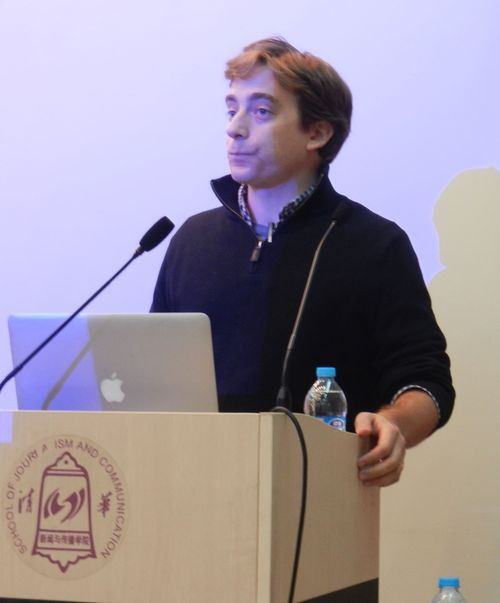
New Yorker writer Evan Osnos is as fine a storyteller in person as he is in print. Tsinghua University journalism students left their texting thumbs idle Oct. 24 as he told how he profiled a former barber named Siu Yun Ping, who won close to $100 million at baccarat in Macau.

Osnos shared some trade secrets about writing for The New Yorker, which is known for its profiles of the famous and obscure.

The best writing starts with deep reporting, he said. It flows from the detail gathered from court documents, news clips, obscure academic dissertations, neglected public archives and reluctant interview subjects. In other words, gather the facts, and you will have the material for colorful writing.

Thursday, October 25, 2012

How to tailor news for 4 different platforms? 'Responsive design'

Versión en español aquí.

The Poynter Institute held a conference last week to showcase its latest study of how tablet users consume news and the problems designers have in satisfying these users' demands.

Tablets are rapidly becoming a platform of choice, with 22 percent of U.S. adults owning one, double the percentage of just a year ago, according to a Pew study.

Economy-minded publishers are trying to find ways to "publish the content once and have it adapt to all platforms"-- mobile, tablet, online and print -- Sam Kirkland writes.

Monday, October 8, 2012

This interview was originally published in the magazine Periodistas (Journalists), a publication of the Federation of Journalist Associations of Spain (FAPE), and is translated below. (Here is the original in Spanish.)

By Marta Molina, Editor, Periodistas

James Breiner is, along with guru Jeff Jarvis, one of the most consulted U.S. experts on new digital media. A tireless promoter of entrepreneurial journalism and new business models, he maintains that the days of the big media monopolies have come to an end.
Q. Why should someone launch a media project when the industry is falling apart?
 Breiner: Journalists complain that they have lost control of their work to the business interests of the publishers. They would like to make decisions more and take orders less. This is actually the best time to act. The weakness of big media creates opportunities for upstarts. Big media are abandoning entire categories of coverage that readers appreciate, and new media can take advantage of that to fill the gaps. It's possible now to launch a digital publication with a small investment. Generating revenue is tricky, but the opportunities are there. There are some who get started in their free time while they have a steady income. If you should find yourself unemployed, take advantage of the time to develop the project you always dreamed about.

Q. The Spanish media industry has done away with more than 5,000 jobs in recent years, however we are light years behind the U.S. in entrepreneurial culture.
Breiner: When confronted with these scary numbers one could conclude that there is no hope for the profession in Spain. I don't want to minimize the current crisis, but a recession also creates opportunities. There is less competition, competitors are weak or nearing bankruptcy. True, the print industry is near the point of economic collapse, but some will discover the basis of a new order in digital media. It could be you. Go for it!

Tuesday, October 2, 2012

Social media challenge Google for news distribution

The importance of search engines to traffic on news sites spawned an industry of consultants on search engine optimization (SEO). But now social media may be challenging the dominance of "Google juice."

The percentage of Americans getting their news via social networks such as Facebook, Twitter and Google+ has risen to 19 percent, more than double what it was just two years ago, according to a Pew study of news consumption habits. 

The data point that should get the attention of newspaper publishers is that almost as many  Americans (19 percent) are getting news through social networks as from print editions of newspapers (23 percent). (Note: In both cases, the survey asked people where they got news yesterday.)

Monday, September 24, 2012

Countries wary of Internet, despite economic benefits


Reed Hundt
A single digital marketplace where ideas and goods flow freely across borders offers great potential for economic growth. It also makes many national leaders worry about loss of control of their people and culture.

Whether and how to control the Internet is the biggest unanswered question facing countries today, said Reed Hundt, who helped develop many of the policies that govern the web when he was chairman of the U.S. Federal Communications Commission in the 1990s.

He made his comments Sept. 24 during a lively discussion at Tsinghua University School of Journalism and Communication. Students argued about whether to censor web material such as the video that insulted the prophet Muhammad and led to anti-U.S. demonstrations and violence in several Islamic countries.

Saturday, September 15, 2012

Journalism schools could re-invent the industry

Newton (Knight Foundation
photo)
(Versión en español aquí.)

University journalism programs are not changing fast enough to meet the needs of students entering an industry in which job opportunities lie in ventures that are entrepreneurial and multimedia, say experts writing a series of articles for Nieman Lab.

One of the commentators is Eric Newton, who says it is not enough to make changes every few years; schools need to embrace a culture of continuous change or rapidly become irrelevant.

Monday, September 10, 2012

You don't need all the skills to get started

Entrepreneurial journalists have a tough job.

They need skills not only in journalism but marketing, technology, sales, managing online communities and basic accounting, among other things. Fortunately, they don't need to have all the skills mastered at once.

Start small, but start

This is one of the takeaways from entrepreneurs profiled in Mark Briggs's book “Entrepreneurial Journalism: How To Build What's Next for News.” 

The profiles should give hope to beginners because the founders of successful web ventures such as Paid Content, Talking Points Memo and West Seattle Blog started small and gradually built their sites into authoritative sources in their respective niches.