Once again I find myself learning new things from my students here in China. The social media marketing strategies they proposed in class included techniques and platforms I was ignorant of.
Their assignment was to recommend a strategy for a news organization or business that they would like to work for. They chose, among others, the Wall Street Journal, China Daily, Xinhua News Agency, Financial Times, Economic Observer, Tanzania Broadcasting Corp., Ikea, Whirlpool appliances, and Elle magazine.
Several of the marketing plans included WeChat, which is a free text- and voice-message service for cellphones. WeChat allows its 300 million users worldwide to connect with anyone in their phone's address book. It has added 100 million users since September.
Showing posts with label Tsinghua University School of Journalism. Show all posts
Showing posts with label Tsinghua University School of Journalism. Show all posts
Thursday, May 30, 2013

Monday, December 17, 2012
Mark Briggs: create labs for journalism innovation
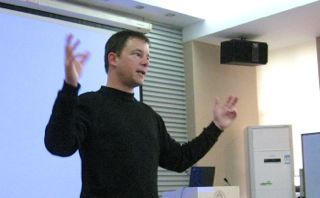
The dilemma for journalism schools dealing with rapid technological change is to decide whether what they are teaching today will be relevant a few years from now.
Many of the social media tools that are transforming journalism and society did not even exist just five years ago, said Mark Briggs, author of "Entrepreneurial Journalism."
"What should journalism schools be teaching five years from now?" he asked during a lecture to students and faculty at Tsinghua University Dec. 14. It is hard to predict, he admitted. His last three jobs -- managing websites for newspapers and a TV station -- did not exist when he was in journalism school. How can we prepare students today for jobs that do not yet exist?
In an environment of rapid technological change, he says, journalism educators need to do at least four things:
Monday, October 29, 2012
New Yorker's Osnos: Good writing flows from deep reporting
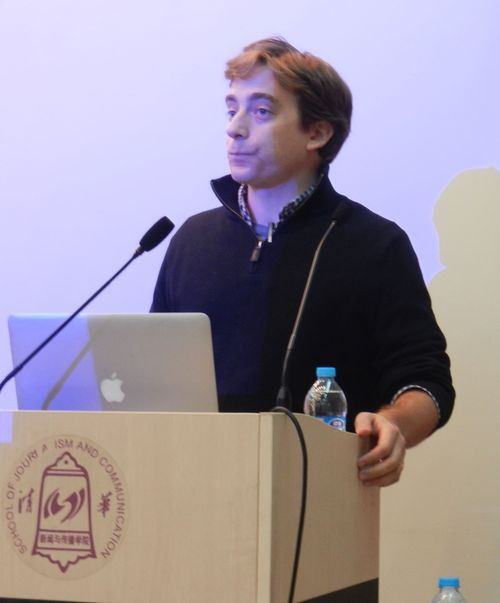
New Yorker writer Evan Osnos is as fine a storyteller in person as he is in print. Tsinghua University journalism students left their texting thumbs idle Oct. 24 as he told how he profiled a former barber named Siu Yun Ping, who won close to $100 million at baccarat in Macau.
Osnos shared some trade secrets about writing for The New Yorker, which is known for its profiles of the famous and obscure.
The best writing starts with deep reporting, he said. It flows from the detail gathered from court documents, news clips, obscure academic dissertations, neglected public archives and reluctant interview subjects. In other words, gather the facts, and you will have the material for colorful writing.
The best writing starts with deep reporting, he said. It flows from the detail gathered from court documents, news clips, obscure academic dissertations, neglected public archives and reluctant interview subjects. In other words, gather the facts, and you will have the material for colorful writing.
Monday, September 24, 2012
Countries wary of Internet, despite economic benefits
 |
| Reed Hundt |
A single digital marketplace where ideas and goods flow freely across borders offers great potential for economic growth. It also makes many national leaders worry about loss of control of their people and culture.
Whether and how to control the Internet is the biggest unanswered question facing countries today, said Reed Hundt, who helped develop many of the policies that govern the web when he was chairman of the U.S. Federal Communications Commission in the 1990s.
He made his comments Sept. 24 during a lively discussion at Tsinghua University School of Journalism and Communication. Students argued about whether to censor web material such as the video that insulted the prophet Muhammad and led to anti-U.S. demonstrations and violence in several Islamic countries.
Subscribe to:
Posts (Atom)