Sunday, January 29, 2017

A voice for free speech in a free world

Marty Baron, center, with U. of Navarra faculty and students. Photo by Manuel Castells

Marty Baron, editor of the Washington Post, came to speak at University of Navarra events in Madrid and Pamplona last week.

Baron's message made me proud to be an American and a journalist. The whole world looks to the U.S. for leadership. Here is an excerpt from his speech in Madrid.

"At the center of our mission is journalism that holds powerful institutions and individuals accountable. We have an obligation to speak truth to power. And the powerful in our world should never be allowed to suppress it.
For all the challenges we face in the media today, this is the greatest. It is why we as journalists must stay faithful to our central purpose. Someone must still tell things as they really are.
No government power, no powerful institution, and no powerful individual should have the right to stop us. And we in the press should not stop ourselves because of fear or self-censorship. These are times to remind ourselves what it means to be a free people, times to think hard about what is required of us if we wish to hold on to the freedoms that we value.
In too many countries, in too many ways, our liberties are being placed at risk. Among those most in jeopardy are free expression, including a free press. For those of us who work in the press, and for all who cherish the free expression that gives meaning and life to our democracies, the quality we now need most, is courage."

Sunday, January 22, 2017

How digital media monetize their social capital

From GDJ's Clipart, Openclipart.org
Lately I have been reading a lot about a new way of valuing media that would benefit entrepreneurial journalism ventures, which nearly always lack capital to launch and sustain themselves.

Sociologists and economists have been writing about it for years -- social capital -- and I am embarrassed to say that I have just started learning about it. 

Social capital is a value that media entrepreneurs possess through their ethnic, social, professional, and business networks. It is also a value that they create through their work's impact on society. Below I will show how three entrepreneurs are making it work, in France, Holland, and Spain.

Versión en español

Hard to value

Investors, the public, and the media entrepreneurs themselves have tended to undervalue their work because it is hard to place a value on their social capital. By contrast, it is easy to value a publication through the advertising and subscription revenue it generates and the capital assets it owns. 

Thursday, December 22, 2016

Honeymoon at the Washington Post: what's next?

Executive Editor Marty Baron interviews Post owner Jeff Bezos. (Washington Post photo)

Note: Marty Baron will be speaking here at the University of Navarra in Pamplona, Spain, on Jan. 26.

The Washington Post is following the strategy of world domination of its owner, Jeff Bezos, the founder and CEO of Amazon, the world's largest online retailer.

In contrast with most of the newspapers in the U.S. and Europe, the Washington Post is hiring journalists and engineers, investing in new technology, and expanding into new markets. Bezos has  global ambitions for the Post, as Newsweek detailed in a recent analysis. 

In the same way that he built the business of Amazon, Bezos has committed to absorbing financial losses in the short term with an eye toward gaining market share over the long term. It's a strategy that requires an owner with deep pockets.  

Monday, November 28, 2016

If you don't have money, use social capital

Image from MCMcapital.com
Digital media entrepreneurs often lack the financial capital and business savvy to launch and sustain a high-quality news operation.

They could improve their reach, impact, and sustainability if they knew how to harness social capital in the form of partnerships with universities, broadcasters, foundations, for-profits, and nonprofit organizations.

Most digital media startups have trouble raising financial capital. They can't get loans because they don't have anything to pledge as collateral other than their personal home and auto. They can't get investors interested because they lack a business model with a promise of profit.

 What is their social capital?
  • A veteran journalist has a reputation in the community as a trusted source of information. Their name is their brand with readers and potential sponsors.
  • They may have a relationship with a university where they have occasionally lectured or even taught entire courses. A university could provide volunteer labor, equipment, and even broadcasting facilities for a startup. The startup would be a teaching laboratory for students.

Tuesday, November 22, 2016

Why fake news is beating traditional news

Traditional news organizations made a deal with the devil when they turned to social media and search-engine optimization to gain digital audience and revenue.

They recruited "community managers" to raise their profile on Facebook, Twitter, Instagram, and the like. They tagged their articles to raise them in search results.

The devilish side of the deal was that presumably ethical news media were trying to sell credibility and verified information -- facts -- within a turbulent ocean of emotion. On social media, feelings are more important than facts. People want to declare who they are and what they believe. So they "like" and share stuff that reinforces their view of who they are and what they agree with. Emotions predominate over facts.

Versión en español

Articles that are popular, shared, and linked to will rise to the top of search results in Google and other search engines. It's easy to share or like something that reinforces your view of who you are.

Misreading the data

So the post-election idea now being championed by many journalists that Facebook and other social media should be fact-checked, and that fake news stories could be eliminated from social media shows they misunderstand the new media dynamics.

Tuesday, November 8, 2016

Media value lies in relationships, not scale

Amid all the news about how Facebook and Google are devouring the world, I would like to sound a note of optimism for digital news media. But first, let's acknowledge the bad news.

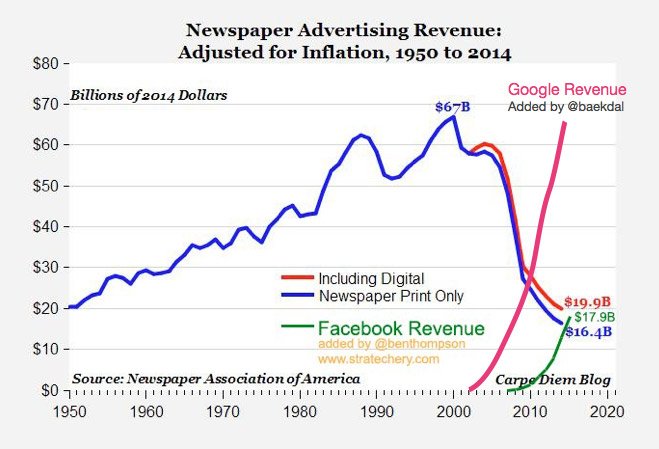
It is true that the munch munch munch you are hearing is the sound of the Internet giants biting off big slices of the digital advertising pie. However, much of that has been at the expense of traditional news media. There is an opportunity for digital-only news media to fill the gap in local coverage.

In the short term, this is not something to celebrate, since the decline of newspapers in particular has led to a big loss in watchdog journalism on the local level. The chart below, which has been published widely, shows the rise of Facebook and Google's advertising revenue concurrent with the decline in newspaper ad revenue.

With information from Thomas Baekdal @baekdal and Ben Thompson @benthompson of Stratechery.com.

Monday, October 17, 2016

Sage advice from Spain's 'mastermind of startups'

Antai Venture Builder nurtures startups. Photo by Caterina Barjau, in El Pais.
Miguel Vicente was an industrial engineer with a hefty salary when he decided to throw it all overboard nine years ago and launch a coupon site.

He gave some memorable quotes that should be heeded by any entrepreneur during an interview with Daniel Verdu of Spain's prestige daily newspaper, El Pais.

"It's like the two pills in Matrix, you have two options: the blue one is for a secure paycheck at the end of the month, the support of a big group that will help you, nice vacations and weekends. And the red pill is the one for entrepreneurs: you won't have anything you had before and you won't even know if you will be around the next day. But you will be the owner of your destiny. That feeling, plus the notion that you cannot fail, makes you pull out the best of what you have inside." 
His first startup was called Lets-Bonus. He sold that and eventually he and two partners launched Wallapop, a mobile app with location technology for buying and selling second-hand goods with nearby users. It is similar to a CraigsList for Spain and has reportedly attracted more than $100 million in investment. Some speculate that its market value might be $1 billion, unicorn territory.