Sunday, October 2, 2016
How a musician views piracy and streaming
In May I was in New York at an academic conference and had time to spend with my son, Patrick Breiner, a jazz saxophonist.
I wanted to hear what he had to say about the economics of the music business from his perspective. He ended up talking more about relationships than economics.
Patrick says that in the digital world, the connection between the artist and their work is intangible. So the act of downloading the work for free "doesn't feel the same as taking a physical thing from a store or a person."
"When you download content for free, at least in my experience, my relationship to that content is cheapened."
Patrick, 32, says he has downloaded lots of material for free from libraries and other sites, and never listens to it. On the other hand, the music he has bought and literally invested in -- whether from streaming services, CDs, or vinyl albums -- "I listen to all the time."

Thursday, September 22, 2016
"It's not students with smartphones but professors' teaching methods that are to blame"
I want to share with you my translation of a blog post (Spanish) by my friend and colleague Jose Luis Orihuela, a professor at the University of Navarra, author, and keynote speaker.
Orihuela is addressing a problem that faces many teachers and professors: they say their students are distracted by all the media on their smartphones and are not paying attention in class.
Don't blame the students, he says. Blame the professors.
"It has to be said again: the problem is not that the student is distracted by technology but that the professors have to change their methods and the content of their teaching.
"It's easy to place the blame on the students and their devices; the hard thing to do is redesign education to adjust to a culture of connectivity. You can't teach against the culture of the students. You have to build on top of it."
He mentioned a well publicized column by a professor in Uruguay who decided to throw in the towel rather than fight against students using Whatsapp and Facebook in his classes.
Orihuela went on, however, to says he encourages those teachers who are adapting and admires those who are changing.
Orihuela went on, however, to says he encourages those teachers who are adapting and admires those who are changing.
The real challenge isn't students using tech devices in the classrooms, but rather professors learning to be digitally literate.
In this video (Spanish), Orihuela elaborates on the topic:
Friday, July 22, 2016
'Distributed content' expands reach, weakens influence of news organizations
The following is an excerpt from my chapter of a book on digital news media that will be published shortly, in Spanish.
Among the most important developments in digital journalism in 2015 was the emerging practice of creating, distributing, and monetizing news known as "distributed content".
What it means: news media organizations hand over their content to platforms like Facebook without linking back to their own websites so that smartphone users can get nearly instant access to the content without having to wait five to 10 seconds for it to display -- an eternity for impatient mobile consumers.
Versión en español
Snapchat was the first platform to stake a claim in this new territory of competition when it launched its Discover channel in January of 2015. Facebook followed in June with its “Instant Articles”, and others such as Google, Instagram, and Apple quickly jumped on the bandwagon.
These social and technological platforms had at least three motivations, according to Josh Constine of Tech Crunch. They wanted to avoid having users abandon a link to news content because of a slow download; they wanted to keep users in their own walled gardens to prevent them from going to other platforms; and, finally, they wanted to take advantage of the audience's attention to send them targeted advertisements, tailored to their personal tastes, preferences, and buying habits.
Among the most important developments in digital journalism in 2015 was the emerging practice of creating, distributing, and monetizing news known as "distributed content".
 |
| Bell: 'Facebook is eating the world.' |
Versión en español
Snapchat was the first platform to stake a claim in this new territory of competition when it launched its Discover channel in January of 2015. Facebook followed in June with its “Instant Articles”, and others such as Google, Instagram, and Apple quickly jumped on the bandwagon.
These social and technological platforms had at least three motivations, according to Josh Constine of Tech Crunch. They wanted to avoid having users abandon a link to news content because of a slow download; they wanted to keep users in their own walled gardens to prevent them from going to other platforms; and, finally, they wanted to take advantage of the audience's attention to send them targeted advertisements, tailored to their personal tastes, preferences, and buying habits.
Tuesday, July 12, 2016
Forget about the big numbers; go for loyalty, trust
Anyone who has studied the metrics of the internet in any detail knows about the Big Lie: those big numbers of total users and page views that everyone relies on are practically meaningless.
In other words, millions of clicks or millions of users are not an indication of trust in a particular news brand or loyalty to that brand. We need new metrics, better metrics.
Versión en español
So it was heartening to see this reality affirmed by of one of the leading lights of digital media innovation, Jon Slade of the Financial Times, in an interview with Ian Burrell (thanks to NiemanLab for the lead):
- More than half of the visitors to websites stay for less than 15 seconds.
- Three-fourths of the users of the most important news sites in the U.S. visit only once or twice a month. How can you even consider them users?
- Half of the internet users in 26 countries are getting their news through social media rather than the originating news sites themselves, according to the Reuters Institute's Digital News Report 2016.
- 43% of social media users don't know where the stories they read originally appeared.
 |
| Jon Slade of the Financial Times |
Versión en español
So it was heartening to see this reality affirmed by of one of the leading lights of digital media innovation, Jon Slade of the Financial Times, in an interview with Ian Burrell (thanks to NiemanLab for the lead):
“I've seen data recently that says that of all the pages on the internet less than 1% of them are from newspapers – the vast majority of time spent is with social channels and they are always going to be much bigger than you are – so if you’re trying to play a game of scale then you’re going to lose.”There are only a few international brands that have even a slight chance of competing with the likes of Facebook and Google for the digital advertising dollars that are based on the number of eyeballs delivered to specific ads.
Friday, June 24, 2016
Media entrepreneurship takes hold at universities
Journalism professors are adapting to the realities of a historically tough job market. Their graduates are struggling to find stable work in an industry whose biggest players have been cutting staff for a decade.
 So universities are teaching new skills -- multimedia production, community management, data management and visualization, among others -- as well as the traditional reporting, writing, and audivisual production skills.
They are also finding new business models. While the traditional media companies are hamstrung by mountains of debt and declining revenue, universities are stepping up to innovate and create new forms of journalism for the digital age.
A Facebook group for those interested in teaching media innovation and entrepreneurship has reached 800 members. And the City University of New York's Graduate School of Journalism is about to hold its third summit for educators in this growing field on July 15. Jeff Jarvis and Jeremy Caplan have been leaders in this field. I participated in the first two summit.

They are also finding new business models. While the traditional media companies are hamstrung by mountains of debt and declining revenue, universities are stepping up to innovate and create new forms of journalism for the digital age.
A Facebook group for those interested in teaching media innovation and entrepreneurship has reached 800 members. And the City University of New York's Graduate School of Journalism is about to hold its third summit for educators in this growing field on July 15. Jeff Jarvis and Jeremy Caplan have been leaders in this field. I participated in the first two summit.
Wednesday, June 22, 2016
Spain's most successful digital journalism startup
In our search for the next big thing, we often overlook some of the steady innovators who grow organically without millionaire investors or crushing debt loads.
One such example is El Confidencial of Spain (their slogan: "The preferred daily of influential readers").
This is a digital news publication whose value proposition for 15 years has been to offer quality news exclusives "that other media cover up or don't publish because of their overlapping political and business interests," according to researcher Alfonso Vara-Miguel, professor at the University of Navarra (in Innovación y desarrollo de los cibermedios en España, 2016, Eunsa, Pamplona, pp. 166-77).
Spanish news consumers are more skeptical of their news media than most (more on that below), so this independent-spirited publication, with a philosophy of spending no more than it takes in, has racked up some impressive numbers:
Versión en español
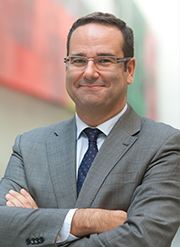 |
| Alfonso Vara-Miguel of UNAV |
This is a digital news publication whose value proposition for 15 years has been to offer quality news exclusives "that other media cover up or don't publish because of their overlapping political and business interests," according to researcher Alfonso Vara-Miguel, professor at the University of Navarra (in Innovación y desarrollo de los cibermedios en España, 2016, Eunsa, Pamplona, pp. 166-77).
Spanish news consumers are more skeptical of their news media than most (more on that below), so this independent-spirited publication, with a philosophy of spending no more than it takes in, has racked up some impressive numbers:
- advertising revenue exceeded US $9.9 million in 2014
- after-tax profits were US $1.3 million in 2014
- full-time staff numbered more than 100
- it averaged 735,000 daily readers in August 2015 (ComScore)
 |
| The value proposition is exclusive journalism free of political and business influence. |
Versión en español
Saturday, May 28, 2016
12 road maps for sustainable digital media worldwide
 |
| Renaissance maps showed monsters, hazards to avoid. |
Like the explorers and navigators of the Renaissance, various organizations – governments, NGOs, journalism groups, and universities, among others – have been trying to map the most promising routes to sustainability in the new media ecosystem.
It's not just about making money; it's about providing news and information crucial to a democratic society.
Versión en español
(At left, a map from Chet Van Duzer's book Sea Monsters on Medieval and Renaissance Maps. Click to enlarge.)
As
traditional news media organizations have lost revenues, laid off
employees, and reduced coverage, new digital media have emerged as
important players in providing public-service journalism, especially on
the local level.
Databases and promising routes
Researchers from a variety of organizations have
created databases of thousands of new digital media to study best
practices and find new models for sustainability. Below are the 12 studies that I have found useful, mostly taken from a paper I presented at the World Media Economics and Management Conference May 5 at Fordham University in New York City.
Subscribe to:
Posts (Atom)